Projects and Research
Geophysical Research at Cal Poly San Luis Obispo
I work in a supervise student research projects (i.e. independent study, senior projects, or just hanging around a field project) in the two primary areas outlined below.
If you are a student interested in one of the topics below, or want to get me interested in some other topic (which isn't difficult), please email me or drop by my office sometime.
Near-surface geophysics applied to hydrogeology
I collect near-surface geophysical data (electrical resistivity and seismic methods) to image subsurface structures (e.g. layering, folding, faults) with the goal of understanding the distribution and movement of groundwater.
Lately we have been working in an exposure of weathered Salinian Block granite in Paso Robles, CA. We successfully interpreted a number of electrical resistivity tomography profiles that were collected to detect where the permeable fractured granite exists.
The landowner drilled an exploratory groundwater well based on our recommendation and it wa successful, yielding almost 50 gallons per minute, which is on the high side in such terrains.
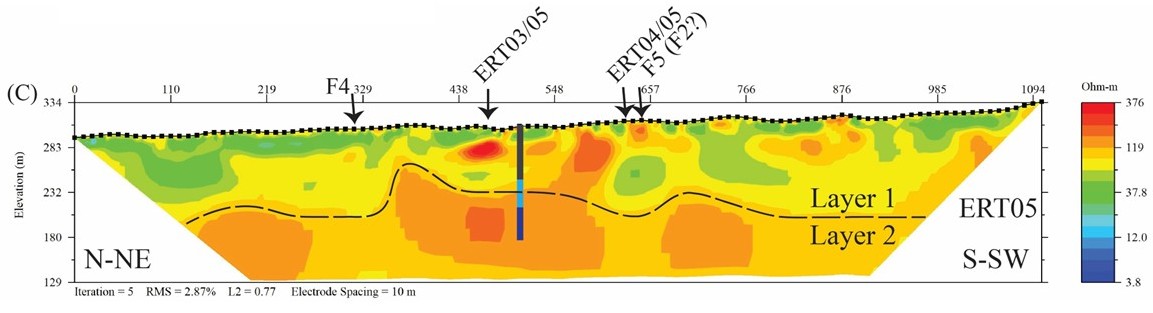
Much more work at this field site as well as other exposures of weather Salinian Block granite (for example, in Santa Margarita, CA) is ongoing/planned. It may be possible to make estimates of hydraulic parameters (e.g. hydraulic conductivity) using electrical resistivity and induced polarization imaging (Revil and Florsch 2010).
Aside from the geophysical imaging, it is possible to think about determining the isotopic groundwater age in the permeable fractured layer and the recharge through the saprolitic weathered layer.
References
Revil, A., and N. Florsch, 2010, Determination of permeability from spectral induced polarization in granular media, Geophysical Journal International, doi: 10.1111/j.1365-246X.2010.04573.x.
Global Seismology
Global seismology analyzes earthquake waves to infer/constrain the earth’s deep interior structure and state.
Ultra-low Velocity Zones (ULVZ) at the Core-mantle Boundary
Recently students have been exploring ultra-low velocity zones (ULVZ) at earth’s core-mantle boundary at 2,900 km depth using PcP and ScP seismic phases. Read an overview of ultralow low velocity zones (Yu and Garnero 2018). Here is a really nice study of ULVZ and ScP waveform modeling (Rost and Revenaugh 2003).
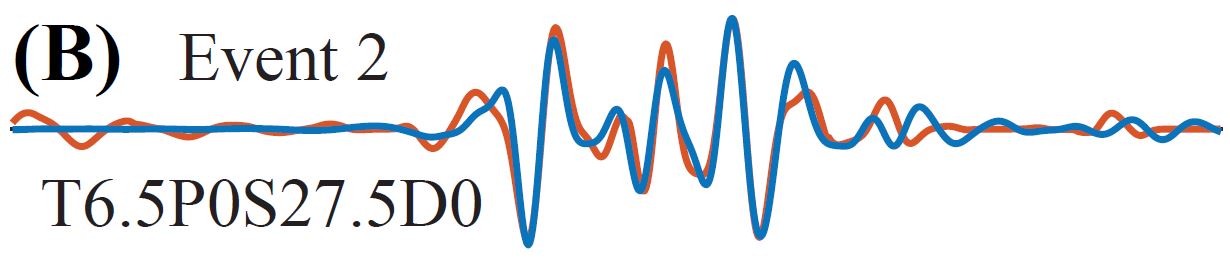
The image below shows a model fit (red: data, blue: synthetic) of ultra-low velocity zone structure using PcP phase arrivals recorded at a high density array.
The PcP phase arrival shows an ultra-low velocity zone structure at the core-mantle boundary. The best fitting one-dimensional ULVZ model has a thickness of 6.5 km and S-wave velocity decrement of 27.5%.
Interestingly, no density increase or P-wave velocity decrement is needed; in fact, increasing the density and/or decreasing P-wave velocity immediately begins to degrade model fit - with the important caveat that these are only one-dimensional models.
References
Rost, S., and J. Revenaugh, 2003, Small-scale ultralow-velocity zone structure imaged by ScP, Journal of Geophysical Research: Solid Earth, 108, no. B1, doi: 10.1029/2001JB001627.
Yu, S., and E. J. Garnero, 2018, Ultralow Velocity Zone Locations: A Global Assessment, Geochem Geophys Geosyst, 19, no. 2, 396–414, doi: 10.1002/2017GC007281.
Core-rigidity Zones
Students are also modeling ScP waves for anomalous structure at the core-mantle boundary. The image below shows a stack (linear and phase-weighted) of P-waves and ScP-waves. The ScP response is suggestive of a core-rigidity zone (CRZ) structure (Rost and Revenaugh 2001), or → direct link to PDF.
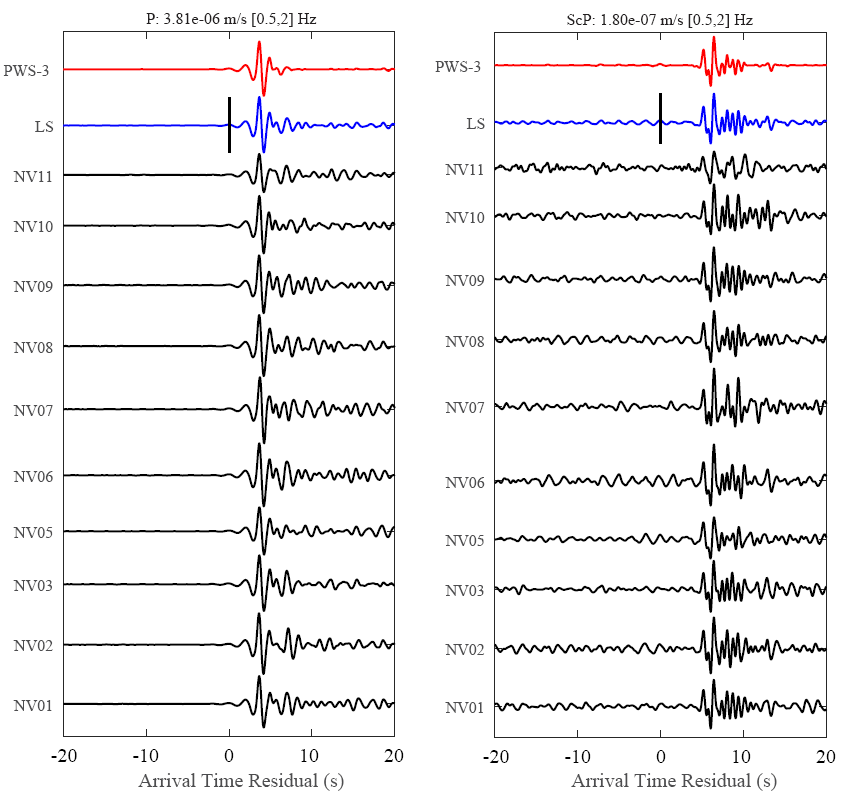
Some observations of a CRZ structure were also detected with ultra-low velocity zone (ULVZ) observations (Rost and Revenaugh 2003) → freely downloadable from Journal of Geophysical Research. The above two references are the only previous CRZ observations in the literature I am aware of.
References
Rost, S., and J. Revenaugh, 2001, Seismic Detection of Rigid Zones at the Top of the Core, Science, 294, no. 5548, 1911–1914, doi: 10.1126/science.1065617.
Rost, S., and J. Revenaugh, 2003, Small-scale ultralow-velocity zone structure imaged by ScP, Journal of Geophysical Research: Solid Earth, 108, no. B1, doi: 10.1029/2001JB001627.